
Author

Full name
Job title, Company name
The diet and nutrition app market reached $2.14 billion in 2024 and is projected to hit $4.56 billion by 2030. However, 70% of users abandon nutrition apps within two weeks if tracking feels too complex or time-consuming.
The difference between apps users delete and apps users keep comes down to one thing: eliminating friction from food logging.
The patterns that drive nutrition app success are quite well defined by research. There are three core pillars:
Understanding user priorities and needs is essential when building a nutrition app that users stick to.
Building a food recognition feature from scratch means 6-12 months of development, plus ongoing maintenance as nutrition data changes and new products launch.
Most teams underestimate the technical complexity: computer vision to identify items, portion estimation from varied photo angles, mapping foods to databases, and delivering results in seconds. A model trained on American foods will fail on Asian or European cuisines, requiring millions of labeled images across cultures, resulting in a costly undertaking.
A nutritional value API, like Spike, solves these challenges and delivers four key benefits:
If instant food recognition, global coverage, and rapid integration sound like what your app needs, here's how Spike Nutrition AI addresses the core challenges:
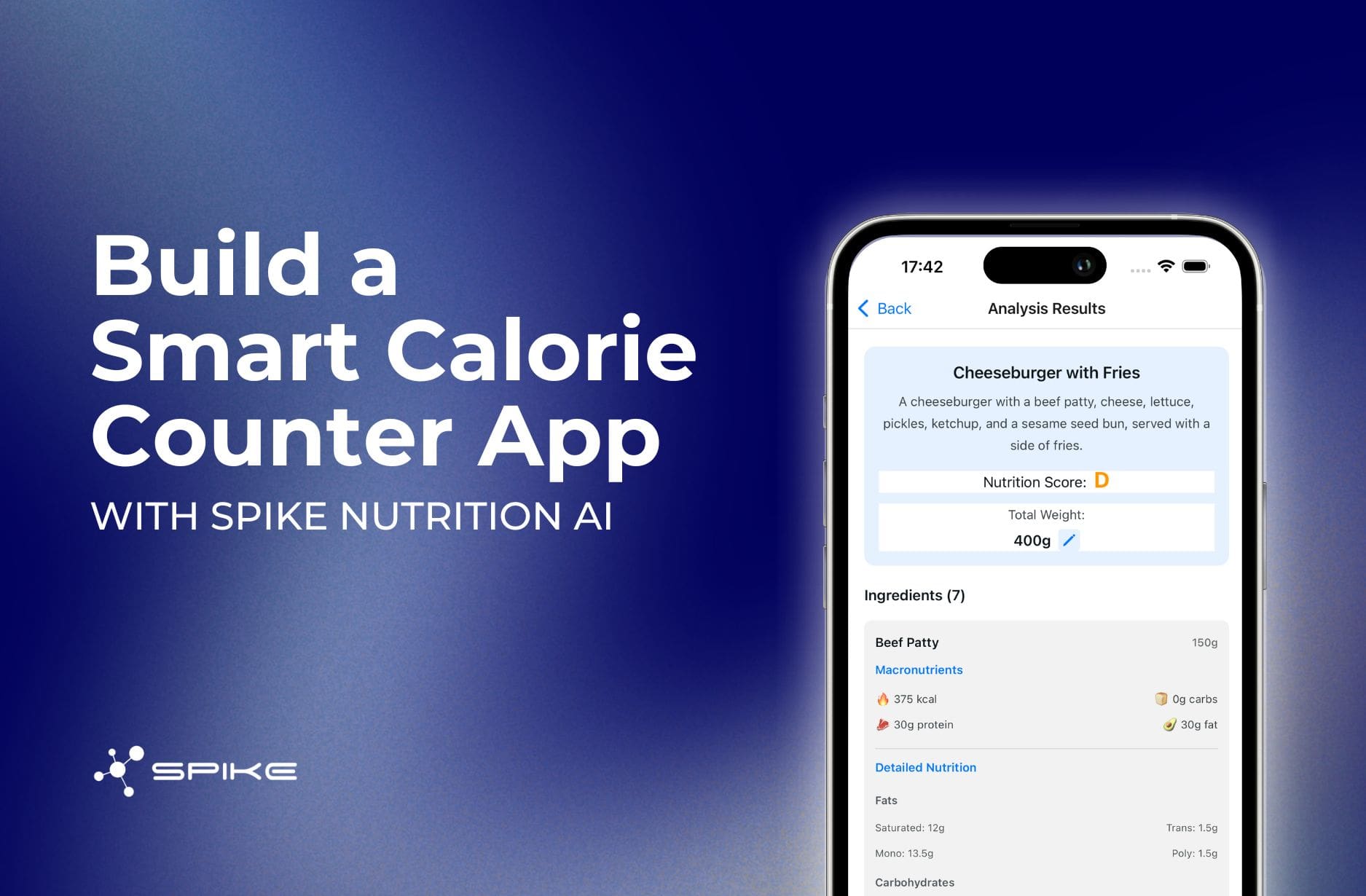
Instant food recognition. Users snap a photo and receive a complete nutritional analysis in seconds. The AI identifies multiple food items in a single image, estimates portions, and returns detailed breakdowns of calories, protein, carbs, fat, fiber, and micronutrients.
Global coverage. Regional optimization uses country-specific nutrition databases to recognize local dishes and ingredients accurately. Spike also supports translation across 180+ languages, meaning your app works for users worldwide. Spanish speakers see "pollo a la parrilla," while English speakers see "grilled chicken" from the same meal photo.
Flexible processing options. Choose between fast models for real-time consumer interactions or precise models for research-grade analysis. Synchronous processing delivers instant feedback, while asynchronous processing handles batch imports efficiently.
Simple integration. Clients have successfully implemented it in as little as 24 hours. We provide detailed documentation and assign an implementation engineer to help throughout the integration process.
The Nutrition AI handles the technical challenges: food recognition, portion estimation, nutritional calculations, and database maintenance, so you can focus on creating the user experience that differentiates your app.
If Spike Nutrition API sounds like something your calorie tracking app could use, schedule a call to discuss in detail.
Grand View Research. (2024). Diet and nutrition apps market size & industry report, 2030. https://www.grandviewresearch.com/industry-analysis/diet-nutrition-apps-market-report
Market.us. (2025). Diet and nutrition apps statistics and facts (2025). https://media.market.us/diet-and-nutrition-apps-statistics/
van der Haar, S., Raaijmakers, I., Verain, M., & Meijboom, S. (2023). Incorporating consumers' needs in nutrition apps to promote and maintain use: Mixed methods study. JMIR mHealth and uHealth, 11, e39515. https://doi.org/10.2196/39515
Vasiloglou, M., Christodoulidis, S., Reber, E., Stathopoulou, T., Lu, Y., Stanga, Z., & Mougiakakou, S. (2021). Perspectives and preferences of adult smartphone users regarding nutrition and diet apps: Web-based survey study. JMIR mHealth and uHealth, 9(7), e27885. https://doi.org/10.2196/27885
Most developers complete basic integration within a few days, but there are success cases of launching in 24 hours.
Recognition quality depends on training data diversity. Spike Nutrition AI models use multi-regional datasets covering diverse cuisines and support translation to 180+ languages. Regional optimization with country-specific databases significantly improves accuracy for local dishes.
37% of users quit nutrition apps due to high time investment in manual logging. Apps that reduce logging time from minutes to seconds through photo-based tracking see dramatically higher retention and engagement rates.
Feature availability varies by provider and custom add-ons. Advanced solutions can tag meals as vegetarian, vegan, gluten-free, or allergen-containing. Verify the API provides reliable allergen detection if serving users with serious dietary restrictions.
%20(1).png)
%20(2).jpg)
%20(1).jpg)